
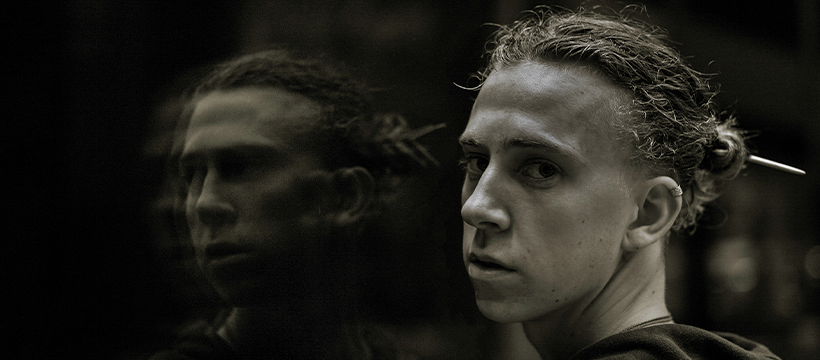
Finnegan Tui is a name rapidly breaking through the noise in London. He is a New Zealand born singer/songwriter/producer with the world at his feet in musical terms. Having recently released his debut single ‘Once I’m Gone’ to the world, the reception to the track has been incredibly positive. Only embarking on his journey now after many years fine tuning his sound, Tui is an artist destined for big things and the opening release reflects this promise.
I caught up with Finnegan for a chat a couple of weeks back and was blown away by his story and journey in music. It gives me a big sense of pride to share this conversation with you all now.
Thanks for chatting Finnegan – Let’s start right at the beginning shall we? Where did your immersion into music come from? I read from your bio that you lived on a bus of some sort back in NZ? Tell us about that.
Ay yeah, my dad made a living by taking a stage from festival to festival. It was a bus and on the roof and behind the bus there was a stage. It was called The Curbside Cabaret. The idea was that anyone could come along and put their name down to play. There was always a wide range of people of various levels of skill signed up each time and the genres were broad. In one evening we could have a drunk triangelist, a jazz trio followed by a reggae group play on the bus. It would get quite incredible as sometimes the main acts at the festivals would pop by and play when the main festival programme had shut. It was an all night thing and this was my childhood, living on the bus.
Being in and around my father’s Curbside Cabaret, I was surrounded by music which over time grew to become a method of communication on the same par as language was for me growing up. My own drive to become an artist came from witnessing a violin and guitar duo play one evening on stage at the Cabaret. I became totally captivated by the violin player; I just couldn’t believe it and was so amazed by the sound. I was five years old and right there and then announced to my father that I wanted to play violin as my profession. He turned to me, ‘if you still want to play the violin when you are six years old, we’ll get you one’. I sure did, and they got me one.
Playing the violin at the festivals became the next stage of my musical development. I’d find gaps in the line up and as a six year old and walk up and play a few notes to a couple of hundred people. I wouldn’t even know how to hold the violin, let alone play a tune, but it was accepted and the audience took to me and encouraged me to continue. Some even gave me money. I think that was the pinnacle of my career actually.
We eventually parked the bus outside a friend’s house and we had a more normal existence where I attended school along with my sister. I picked up the guitar in school and went to lessons with an eccentric German teacher called Deiter Burmeister. He took me under his wing as quite a serious demo of a student. This was my first introduction to practice, theory and harmony. I was completely fascinated by music as a form of art, mathematics and architecture. I started with Deiter when I was eleven and completed grade eight when I was twelve. It was such a fast-track situation where I think Deiter wanted to see how quickly he could get someone through the grades. The early grade were for electric guitar with grade six, seven and eight focused on Jazz.
As the years went on, I experimented a lot with different sounds and styles to get to where my sound has travelled to now. Folk has always been the genre I liked to listen to the most and through utilizing electronic sounds in my own music making too, I’m able to create the sound you can hear on ‘Once I’m Gone’.
After this interesting music soaked upbringing, your childhood then contained an across the globe move from New Zealand to Devon – how did a young Finnegan Tui react to a change like this?
It was mental.. crazy, I had been on that bus, running around for seven or eight years and then we lived in a six house cul de sac – there was a boy my age in one of the other houses. It was called Whareroa Road. We eventually formed a little gang on the road and would go to the sand dunes everyday, run wild innocently. Suddenly in my early teens I was dropped into a new environment in the UK. The culture was totally different. It went from running around in the dunes of New Zealand to a ‘let’s go drinking, let’s play videogames..’ culture when I arrived in my new home in Devon. Not saying anything bad about the UK at all, but naturally it was a bit of a culture shock.
We all yearn to feel alive and I had that feeling of leaping off a sand dune, climbing a big tree – these were my pastimes. By moving to England it was more of a concrete jungle with less scope for living the life I used to in NZ. To get to know my new boundaries and feel alive again in the UK and feel my childhood excitement, I joined up with a group of free runners. They saw the city as a jungle, jumped around and we travelled everywhere, trying to find freedom in the UK. We hitchhiked everywhere.
Eventually, we got in a spot of trouble climbing a building in London and made the news. I’ll always remember walking into my family house and my mother asking me if I had perhaps climbed a building the day before. My auntie had seen the news segment and recognised me – ‘Daredevils, Brainless Youths Climb Building’, the headline.
Has this longing to be feel present influenced how you compose your music. I’ve noticed through watching your mini-documentary that you often are partial to collecting sounds directly from the environment around us. ‘Gotye’ was the first person I heard doing this. Has anyone else’s work inspired you to record from your surroundings?
The person I saw doing it the most was Cosmo Sheldrake. ‘Found sounds’ are a really fun thing – if you start thinking a lot about your own relationship with the world then a very easy way to explore this is by recording the world that you are in. I think sometimes it’s very easy to think you can just forage through the internet and gather the sounds you need from there. For example, if I was looking for the sound of a storm you would think it would be better to get professional clips online and go from there. Weirdly it doesn’t work like this, I’ve found that there’s something special about recording the sounds yourself.
I enjoy the process a lot more than the outcome in general (which can also be my downfall at times).
***************
Extra Snippet:
*Here’s a little cool snippet from our chat (I couldn’t find a specific place for) of Finnegan explaining how he writes his lyrics (it will become relevant in the next question). He describes his three tick checklist a lyric has to have before he let’s it live within his music.
Every song I write must have:
-A relatable meaning for a child listening:
-A relatable meaning for an adult listening:
-A relatable meaning for someone who listens to the song again and again:
All three are completely separate but as long as those three meanings are there in the lyrics of a song then I’m happy with it.
**************
Moving onto the stunning debut single ‘Once I’m Gone‘ – Could you tell us a bit about that and what it’s all about? Was it hard to make and let go of?
Sometimes it feels like I can’t be completely honest about how much time goes into a song. Usually the song itself in the end doesn’t always necessarily justify how long it took. The bridge of ‘Once I’m Gone’ took me so so long, I just couldn’t do it – I was going off on a musical pilgrimage to get the right balance. It was difficult and one would think the end result would be the world best recorded bridge.
I think the reason the bridge was so hard is because it was the last element to go in. The song was written, recorded pretty much and the final thing to add was the bridge. As a result, it became something that had to be perfect and I didn’t have the same freedom to express myself as I had at the beginning of the writing stage of the song.
Lyrically, ‘Once I’m Gone’ was probably one of the more simplistic songs I’ve written. It ticks the three boxes though.
-It’s about a boy who wants to run away in a storm (this is the relatable meaning for a child.)
–The relationship between a child and a parent or innocence and wisdom – (relatable for an Adult Listener)
-Yearning for a feeling, a sense of belonging, knowing that there’s more to life – (relatable meaning for someone who listens again and again)
It’s essentially about ‘coming of age’.
Do you think the amount of time you spent on ‘Once I’m Gone’ was partly due to it being the first release and the pressure that comes with that?
Not necessarily, I’ve always had this happen to me. There’s a guitar based song called ‘She’ that I wrote a little while ago. It started off as a simple track where I thought it would be pretty easy to record. The formula was intended as ‘Sing, play and record’ – simple. It’s got three hundred different tracks running through it now.
Obviously you’ve been writing music for years, ever since you were a youngster really. Were you always patient about releasing your music at the right time or were you ever thinking ‘I want to be a star now’.
Hmm it’s a good question, I suppose I can sum it up like this:
If I had to impress you with a canvas and a paintbrush and some paint – the easiest way to do this is for me to draw tons of lines, loads of them – a weird maze or technical, geometric pattern. You would look at that and think ‘Yeah, okay, that’s kind of impressive’.
But if I had to impress you with a canvas, a paintbrush and was only allowed to draw three lines, it would be much more difficult as I would have to capture something different and those lines would have to mean more individually.
For me, it’s always been more difficult to write a song with four chords than one with a thousand chords. It’s easy to write something crazy in a session but very difficult when I have to to reduce it down. As soon as reduction became a goal (refining my sound) there was a switch in me where I had a lot more respect for people making songs with four chords. Reducing and learning to refine is the main reason why it took me so long to release my first single.
A few years ago, I released a song called ‘The Mask’ – but it was deemed too long and it took too long to get to the bridge etc. A label advised me against releasing it as it wasn’t refined and easy for the listener. It was disheartening but I subsequently took their advice on board.
Who are your musical Influences, if any: past or present?
The music I listen to is all electronic ambient – Rival Consoles, mainly Rival Consoles actually and some classical stuff. When I was eight years old I had a CD player and used to listen to one CD everyday and it was by The Levellers. I also listened to a Mozart compilation album as a kid and got inspired by it.
Justin Vernon is an influence. I just love ‘Creeks’, he totally captured something special there. I haven’t gone deep into his back catalogue but ‘Creeks’ just hit home.
I also like Trip Hop. Artists like Portishead especially are great. Nick Drake too was a childhood listen.
You are currently and have been working with some top tier producers in London. Namely Charlie Andrew and Matt Lawrence. What’s that been like?
Yeah, It’s amazing working with Charlie. He did wonderful things with Alt-J. They (Alt-J) did a fantastic job of blending styles together – it never sounded like one sound was tacked onto the next, it was seamless production. Charlie was a big contributor to their success and being around him is so cool. He is great.
Matt Lawrence produced ‘Once I’m Gone’ – he has become a mentor for me. His CV is incredible, working with Adele, The White Stripes, Ed Sheeran – so it’s been valuable hearing his thoughts and picking up tips from him.
I’ve seen you’ve collaborated with an Irish Traditional outfit called Lankum – how did this come about and if collaboration is an avenue you’ll be utilising more of in the coming years?
I met Lankum on a trip to Dublin a few years ago. They are amazing and I’m honored to be doing a cover of one of theirs. I love to work with other artists if they are up for it. It’s the beginning for me and I’m very open. I’m going to be heading up to Throwing Snow’s studio in Bath for a few days soon. He has a studio in a castle so that’s going to be super exciting to see what comes of it.
My housemate Jasper is also a producer and we are working together super well. We’ve done two songs already. There are other exciting things brewing too, but I can’t say here.
What’s next for us? What can we expect from you soon?
Yeah, so my best friend Jack Tierney is doing everything visual for me for all of this. We spent a year organising and talking about our friendship and ideas for the music project.
We’ve lived together every day for the last eight years; we are close and came up with an idea for a film about yearning, duality and coming of age. What will happen is that a song will come out alongside a video. Another song will follow with another music video – all separate stories about separate characters. When the album gets released it will be accompanied by a film – there, all the characters will align in one big timeline – a short film of around 30 minutes length which will be called ‘Zephyr’. This will be the name of the record too.
We’ve shot this already over the span of a few weeks and these visuals and this storyline is what’s going on alongside my next releases.
We have a very sucessful Kickstarter campaign to thank for this. Excited to get it all out.
Finnegan Tui‘s next single is titled More and was released on 28th July 2021.
About ‘The Sound Sniffer’
The Sound Sniffer is a music blog that’s still only a baby – Founded in early 2019 by Kevin Coakley, a music writer and ghostwriter. ‘The Sound Sniffer’ also runs gigs and showcases in London since Oct 2019. The showcases are picked from artists found in the blog’s submission inbox.
Check out my Interviews HERE
Find me on:
Facebook
Instagram
Twitter
Rated as a Top Ten Independent Music Blog Globally by Feedspot – VIEW
 The Sound Sniffer
Leave a comment